USF’s Early Warning Signs Finally Catch Up to the Bulls Against Temple
South Florida had spent the first four weeks of the season finding ways to win.
Against FIU, the Bulls scored 19 points. At Army, they needed a late fourth-quarter comeback to escape with a 28-24 victory. Delaware State provided the one true offensive explosion, a 59-17 win that produced 611 yards. Then came Bowling Green, where USF managed only 214 yards and was scoreless through three quarters before rallying for a 14-6 win.
The record looked good.
The football did not always match it.
On Saturday night against Temple, those issues finally caught up with the Bulls.
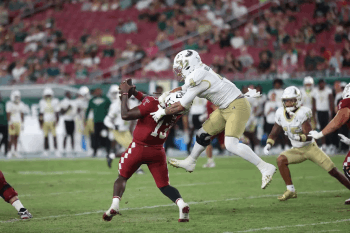
USF fell 17-13 at Raymond James Stadium, dropping to 4-1 and ending a nine-game home winning streak. The loss was not the result of one disastrous performance. It was the latest example of the same offensive inconsistency that had been sitting underneath the undefeated record.
The Bulls simply ran out of room to survive it.
The Delaware State Game Was Hiding Some Problems
The easiest way to look at USF's offense through five games is to point to the 26.6 points and 344.2 yards the Bulls are averaging.
Those numbers are solid.
They also do not tell the entire story.
Take the Delaware State game out of the equation and USF has scored 74 points in four games against FIU, Army, Bowling Green and Temple. That is 18.5 points per game.
The yardage tells a similar story.
USF produced 208 yards against FIU, 369 against Army, 214 against Bowling Green and 319 against Temple. That works out to 277.5 yards per game against those four opponents.
There have been stretches where the offense has looked capable of much more. Michael Van Buren Jr. threw for 239 yards and accounted for four touchdowns against Army. D.J. Crowther ran for 143 yards against Bowling Green. The Bulls piled up 611 yards against Delaware State.
The problem has been putting those performances together consistently.
Instead, the Bulls have repeatedly spent large portions of games struggling to move the football before finding enough offense late to win.
That worked at 4-0.
It was not going to work forever.
The Defense Has Been Good, But It Has Been Asked to Do Too Much
It would be unfair to pin the Temple loss entirely on the defense.
Through five games, USF has allowed 14.6 points per game and 312.4 yards per game. Opponents have scored more than 24 points only once, when Army scored 24 in the Bulls' comeback win.
Against Temple, the defense held the Owls to 274 yards and forced five punts. USF also came up with one of the biggest defensive plays of the night when C.J. Hicks recovered a Temple fumble in the end zone to end a scoring opportunity.
But there is a difference between playing good defense and being able to continually erase offensive problems.
USF's defense had been doing plenty of that.
The Bulls trailed Army by 10 points in the fourth quarter before the offense rallied. They were shut out through three quarters at Bowling Green before scoring twice in the fourth. Against Temple, the defense again kept the game within reach while the offense struggled to get moving.
Eventually, one drive went wrong.
That drive came with 8:32 remaining, when Temple took over at its own 4-yard line after Luke Goater's 56-yard punt.
USF had Temple backed up.
Five minutes and 24 seconds later, the Owls were in the end zone.
Temple drove 96 yards in 10 plays, overcoming a pass interference penalty and another penalty that helped extend the possession before quarterback Ajani Sheppard broke through for a 34-yard touchdown with 3:08 remaining.
That was the first time all season the defense could not find the stop it needed at the end of a close game.
The Offense Kept Putting the Defense in These Spots
The warning signs were already there.
USF entered Temple having scored just 14 points at Bowling Green, with only 83 offensive yards in the first half of that game. The Bulls eventually won because the defense held Bowling Green to six points and the offense finally found two fourth-quarter touchdown drives.
Temple followed a similar script.
USF managed only 108 yards and five first downs in the opening half. The Bulls were also hurt by penalties, finishing the night with eight for 60 yards.
The offense improved dramatically after halftime.
USF opened the third quarter with a 14-play, 75-yard touchdown drive. Crowther finished it with a 1-yard touchdown run. The Bulls then took the lead in the fourth quarter when Nico Gramatica connected on a 49-yard field goal.
But that was it.
USF did not score another point.
Van Buren finished 17-of-32 for 205 yards. Crowther, coming off consecutive 100-yard games, was held to 68 yards on 23 carries. The Bulls finished with 319 total yards, but much of that production came during the stretches when they were finally able to establish some rhythm.
The issue was sustaining it.
Hartline’s Comments Pointed Directly at the Problem
Hartline's comments after the game were notable because he did not point to one isolated issue.
Instead, he described a collection of problems that have been showing up throughout the season.
He cited execution, alignment mistakes, dropped passes and penalties. He also acknowledged that the Bulls have not consistently turned what they do in practice into what happens on Saturdays.
Most telling was Hartline's assessment that the problems were not new.
That assessment fits what has happened on the field.
The Bulls have been winning despite stretches of poor offensive execution. They have been winning despite slow starts. They have been winning despite putting their defense in difficult situations.
Hartline also said after the game that the team needs to make routine plays routine and start faster offensively.
That sounds simple.
The first five games suggest it has not been simple for this team.
The Numbers Finally Matched the Record
There is no reason to dismiss what USF accomplished in its first four games.
The Bulls won at Army. They handled Delaware State. They went on the road and rallied past Bowling Green. They entered Saturday as the only undefeated team remaining in the American Athletic Conference.
But being undefeated did not mean the Bulls had played like an undefeated team for four straight weeks.
There was enough good football to win.
There was also enough uneven football to create questions.
The first-half scoring numbers are especially telling. Through five games, USF has been outscored 47-44 in the first half.
That is not the profile of an offense consistently controlling games.
Against Temple, the Bulls scored three first-half points and trailed 10-3. They responded with a strong third quarter, took a 13-10 lead and appeared to have another close game under control.
Then the defense finally cracked.
And the offense could not answer.
That is what made the loss different from the first four games. USF did not suddenly become a bad football team. It simply could not overcome the same collection of issues that had been lurking underneath the wins.
Hartline put it another way after the game.
That may be the most accurate description of the Bulls five games into the season.
The defense has been good enough to keep USF in games. The offense has shown enough explosiveness to win them. But the Bulls have not consistently played complementary football for four quarters.
Temple made them pay for it.
And with UTSA waiting Thursday night, there is not much time to pretend the warning signs were not there.
They were.
For the first time this season, they simply mattered more than the final score.